Table of Contents
AI CT triage is moving further into mainstream hospital care after the Centers for Medicare & Medicaid Services approved New Technology Add-on Payment eligibility for Aidoc’s CARE Multi-Triage CT Body technology. Beginning October 1, 2026, qualifying Medicare Fee-for-Service inpatient cases using the FDA-cleared system can receive an additional payment under the NTAP program, creating a clearer reimbursement pathway for hospitals adopting the technology.
The decision is significant because the technology is built on Aidoc’s diagnostic artificial intelligence foundation model and can evaluate CT examinations for multiple urgent findings rather than addressing only a single condition. The reimbursement pathway may help hospitals offset part of the cost of introducing the technology while supporting broader use of AI-assisted radiology workflows.
AI CT Triage Receives CMS Reimbursement
CMS approved a New Technology Add-on Payment for CARE Multi-Triage CT Body for eligible inpatient use beginning with the 2027 federal fiscal year on October 1, 2026. Qualifying Medicare Fee-for-Service inpatient cases may receive the add-on payment for the technology during its period of NTAP eligibility.
New Technology Add-on Payments are designed to provide additional Medicare reimbursement for certain new technologies used in inpatient settings when existing Medicare Severity Diagnosis-Related Group payments may not adequately account for their costs. CMS states that technologies applying through the standard NTAP pathway generally must satisfy requirements involving newness, cost, and substantial clinical improvement.
CMS limits NTAP payments under the standard framework to the lesser of 65% of the technology’s cost or 65% of the amount by which the total cost of the case exceeds the standard MS-DRG payment. The actual reimbursement therefore depends on the individual qualifying case rather than representing a fixed payment for every use of the technology.
This distinction is important. The CMS decision does not mean every CT examination performed with Aidoc’s software automatically receives additional Medicare reimbursement. Eligibility is tied to qualifying Medicare Fee-for-Service inpatient cases and applicable CMS requirements.
AI CT Triage Gains an Adoption Pathway
The NTAP decision may reduce one of the financial barriers healthcare organizations encounter when implementing new diagnostic technology.
Hospitals evaluating artificial intelligence must consider software licensing, integration, information technology resources, cybersecurity, clinician training, workflow redesign, and ongoing performance monitoring. Even when a technology demonstrates potential clinical value, these costs can make widespread adoption more difficult.
The availability of an additional Medicare payment does not remove all of those expenses. However, it gives eligible inpatient facilities a defined mechanism for receiving additional reimbursement during the early years of adoption.
Aidoc said eligible cases will have a standardized reimbursement route beginning October 1 and that the NTAP eligibility period is expected to extend over three years.
AI CT Triage Detects Multiple Urgent Findings
CARE Multi-Triage CT Body is a radiological computer-aided triage and notification system designed to analyze contrast and noncontrast CT images involving the chest, abdomen, and pelvis.
The FDA cleared the device in January 2026 for use in adults and transitional adolescents aged 18 years or older. Its purpose is to identify suspected positive findings and alert appropriate medical specialists so potentially urgent examinations can receive earlier attention.
The FDA-cleared indications include:
- Diverticulitis
- Abdominal-pelvic abscess
- Appendicitis
- Intestinal ischemia and/or pneumatosis
- Obstructive renal stone
- Small bowel obstruction
- Large bowel obstruction
- Spleen injury
- Liver injury
- Kidney injury
- Pelvic fracture
The system can flag a study when it identifies at least one suspected finding and provide notifications for the individual findings detected.
That multi-condition capability differentiates the product from many earlier radiology AI applications built to identify a single abnormality.
AI CT Triage Uses a Foundation Model
Aidoc describes CARE Multi-Triage CT Body as being powered by its CARE diagnostic AI foundation model. The FDA documentation also states that the device uses a foundation-model-based artificial intelligence system, with modules fine-tuned from a locked foundation model.
Foundation models represent an important development in medical AI because one underlying model can potentially support multiple related clinical applications after appropriate development and validation.
Earlier generations of imaging AI commonly required separate models for separate findings. A pulmonary embolism algorithm, for example, might operate independently from technology designed to identify fractures, hemorrhage, or abdominal abnormalities.
A foundation-model approach creates the possibility of developing multiple capabilities from a common underlying architecture.
For radiology departments, this could eventually simplify how multiple AI functions are deployed across imaging workflows. However, every clinical use still requires appropriate validation, regulatory authorization where applicable, and monitoring after implementation.
FDA Clearance Supports Clinical Use
The FDA issued a 510(k) substantial-equivalence determination for Aidoc’s BriefCase-Triage: CARE Multi-Triage CT Body on January 7, 2026. The device is classified as Class II radiological computer-aided triage and notification software.
The regulatory documentation makes an important distinction between triage and diagnosis.
CARE Multi-Triage CT Body is intended to analyze CT images in parallel with normal interpretation and notify clinicians about studies containing suspected findings. Its preview images are provided for prioritization purposes and are not intended to replace review of the original diagnostic images.
The system also does not remove examinations from the standard reading queue or deprioritize cases. Radiologists and other appropriately trained specialists remain responsible for reviewing full diagnostic images and applying professional judgment.
This human oversight remains central to the intended workflow.
AI CT Triage Supports Radiology Prioritization
Radiology departments may receive large numbers of CT examinations from emergency departments, inpatient units, trauma services, and outpatient settings.
The order in which those scans are interpreted can matter when a patient has a time-sensitive condition.
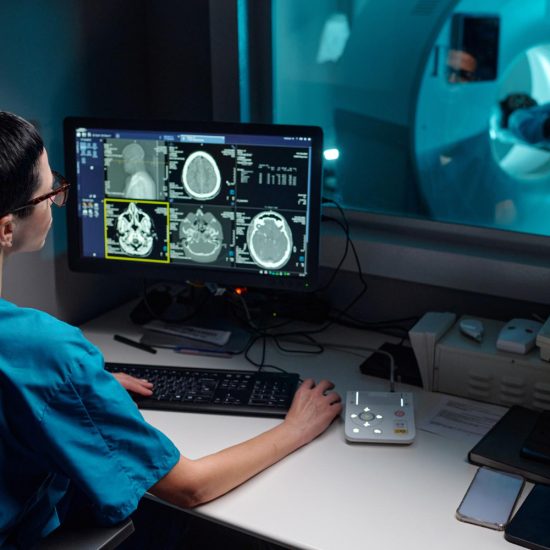
AI triage tools are designed to operate in the background while images enter the normal radiology workflow. When a suspected urgent finding is detected, the software can alert clinicians and help move the case higher in the worklist.
That does not mean the AI provides a final diagnosis. Instead, its role is to help draw attention to examinations that may require faster human review.
CARE Multi-Triage CT Body is specifically designed to flag multiple acute findings from CT examinations of the chest, abdomen, and pelvis. Aidoc says this could create opportunities for faster diagnosis and treatment when urgent conditions are present.
CT Imaging Volume Strengthens the Use Case
The potential impact of multi-condition CT triage is closely related to the large volume of imaging performed in acute care.
According to information cited by Aidoc and Imaging Technology News, abdominal CT accounts for more than 40% of CT imaging in the United States, while more than half of acute cross-sectional abdominal imaging takes place across inpatient and emergency department settings.
High imaging demand can create workflow pressure when radiology teams must simultaneously review routine studies and identify cases that may contain urgent abnormalities.
AI-assisted prioritization could help organize that workload more efficiently by identifying scans that warrant immediate attention while leaving the final interpretation to clinicians.
The broader value proposition therefore extends beyond simply detecting abnormalities. Hospitals may evaluate the technology based on whether it improves turnaround times, accelerates escalation of urgent findings, integrates into existing radiology systems, and supports more efficient use of specialist capacity.
Medicare Reimbursement Could Accelerate Adoption
The lack of a clear reimbursement strategy has been one of the challenges facing many clinical artificial intelligence technologies.
Hospitals may recognize potential workflow or clinical value but still struggle to justify the investment when the software generates no direct reimbursement.
NTAP eligibility provides a different financial framework.
CMS explains that the program exists to ensure adequate inpatient payment for certain new medical technologies before their costs are fully reflected in standard Medicare payment calculations.
For Aidoc, the decision creates a pathway for qualifying hospitals to receive additional payment while the technology remains new.
The reimbursement decision may also attract broader attention because CARE Multi-Triage CT Body is built on a diagnostic foundation model. Imaging Technology News described the decision as a novel reimbursement milestone for an AI product built on this type of healthcare foundation-model architecture.
Hospitals Still Need an AI Strategy
Reimbursement alone will not determine whether AI CT triage produces value.
Healthcare organizations considering implementation should evaluate several factors before scaling the technology.
These include:
- Clinical sensitivity and specificity
- False-positive and false-negative performance
- PACS and radiology worklist integration
- Alert design and notification fatigue
- Cybersecurity and patient-data protection
- Clinician training
- Performance across different scanners and populations
- Workflow impact
- Documentation and billing requirements
- Monitoring after deployment
Hospitals should also define measurable outcomes before implementation. These could include reporting turnaround time, time to specialist notification, treatment initiation, emergency department throughput, length of stay, or other clinically meaningful measures.
The availability of Medicare reimbursement can support adoption, but organizations still need evidence that the technology improves patient care and fits safely within existing workflows.
Radiologists Remain Central to AI CT Triage
The FDA-cleared role of CARE Multi-Triage reinforces a broader principle for diagnostic artificial intelligence: AI is being introduced primarily as a clinical support tool rather than an autonomous replacement for radiologists.
The software can examine images quickly and flag suspected abnormalities, but specialists remain responsible for reviewing the complete study.
This distinction is particularly important in CT because one examination may contain numerous findings beyond those targeted by an AI system.
A patient scanned for abdominal pain, for example, could have an urgent abnormality that falls outside the software’s cleared indications. Standard radiologist review therefore continues regardless of whether the AI generates an alert.
Used appropriately, AI triage can serve as an additional layer of prioritization while preserving physician responsibility for diagnosis.
AI CT Triage Enters a New Reimbursement Era
CMS approval of NTAP eligibility for CARE Multi-Triage CT Body represents an important development at the intersection of artificial intelligence, medical imaging, and healthcare payment.
The technology combines multi-condition CT triage with a foundation-model architecture and has received both FDA authorization and a Medicare pathway for qualifying inpatient use.
For Aidoc, the decision may lower financial barriers for hospitals considering deployment. For healthcare organizations, it provides another reason to evaluate whether multi-condition AI can improve radiology prioritization and support faster responses to urgent findings.
The larger significance may extend beyond a single product. As more diagnostic AI technologies enter clinical practice, sustainable reimbursement models will increasingly influence which technologies move from pilot programs into routine care.
The challenge now is to demonstrate that AI CT triage can deliver measurable clinical and operational value at scale while maintaining appropriate physician oversight.
CMS reimbursement provides an adoption pathway. Long-term success will depend on whether hospitals can translate that opportunity into faster workflows, reliable clinical performance, and better care for patients with time-sensitive conditions.
For more healthcare industry updates, insights and news, visit DistilINFO. Click here to subscribe to stay informed.