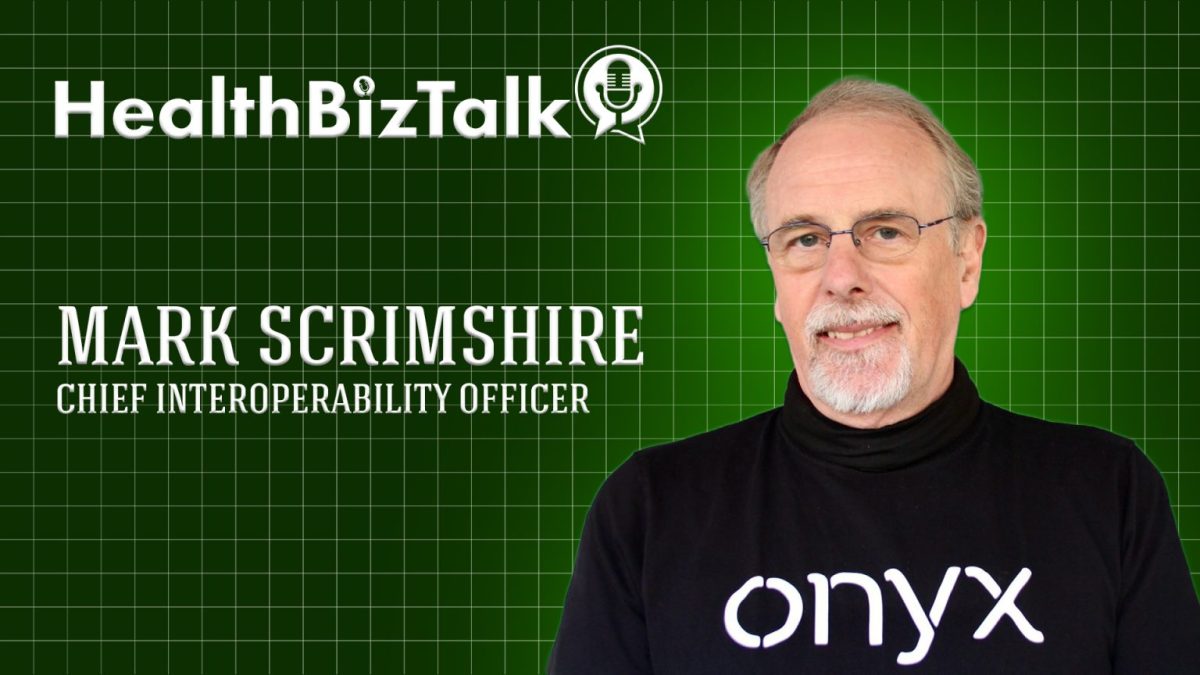
In the HealthBizTalk podcast, Tony Trenkle interviews Mark Scrimshire, Chief Interoperability Officer at Onyx, to discuss the future of healthcare data interoperability. Mark shares insights into enabling seamless data exchange through innovative solutions and the role of FHIR standards in empowering patients.
Transcript Of the Podcast
Welcome to Health Biz Talk, the industry’s leading podcast that brings you today’s top innovators and leading voices in healthcare technology, business and policy.
00:00:09
And here’s your host, Tony Trenkle, former CMS CIO and health IT industry leader.
00:00:16
Good afternoon.
00:00:17
This is Tony Trenkle on Health Biz Talk, and I’m happy to have as my guest today Mark Scrimshire, who’s the Chief Interoperability Officer at Onyx Health.
00:00:30
Mark, welcome.
00:00:32
Hi, Tony.
00:00:33
Great, great to be here.
00:00:34
Thanks for inviting me.
00:00:36
Well, thank you for joining us.
00:00:38
So, Mark, why don’t we jump right into it?
00:00:41
I know you’re a busy man, so we don’t want to take up too much of your time.
00:00:45
So I took a look at LinkedIn and you’ve got a very diverse background and maybe you can tell us a little bit of how you got here today.
00:00:55
How did you become the Chief Interoperability Officer, from your background to getting here in, in the Cliff Notes version, of course.
00:01:06
Okay, the Cliff Notes version.
00:01:08
So.
00:01:08
Well, I mean, I’ve been involved in it since I was a kid.
00:01:13
My parents ran a data prep company in the uk, So I sort of born to it, but really, I suppose the journey into health really started when I came over to the US 25 or so years ago, worked for a startup there, but ended up basically running the IT function for Iridium, the satellite phone company.
00:01:36
When we, we launched that.
00:01:39
And after that I, I got drawn into people wanting me to go work for them and I, there was so many people asking, I decided to set up my own company.
00:01:48
So we did that for, for a good few years and I ended up actually having to write a daily blog for AOL to explain what was happening with what was then web 2.0.
00:02:01
So this was back in like 2008, 7 and 8, right?
00:02:05
Oh yeah.
00:02:06
And I went to one of the, the Web 2.0 conferences.
00:02:09
So I was writing this daily blog for O’Reilly and went to one of these web conferences and there was a, these unconferences going on which were, you know, unscripted.
00:02:20
And there was when you had a bunch of health geeks getting together on a Friday night in San Francisco to talk about tech, IT and technology and healthcare.
00:02:31
You realize there’s something there.
00:02:33
So I ended up starting a health camp as an unconference and bringing all sorts of people together.
00:02:40
And that ultimately led to me, because of the various connections I got whilst I was working for a payer, I, I left the, the particular payer and was really focusing a lot on, on Health Camp and just meeting lots and lots of people and it, we ended up, you know, doing things like supporting the original version of Blue Button, which goes back to, as you know, about 2009, 10.
00:03:09
Right.
00:03:10
And developing some open source stuff around that and healthcamp.
00:03:15
We were always promoting patient access and I had a, you know, a few diversions through working with 3M health information systems, taking their systems to the cloud and ending up where I was invited.
00:03:31
I was more or less told to go and apply to CMS or to the, the Idea Lab at HHS and went through that process and got the opportunity to go and work on Blue Button at cms.
00:03:50
So that really took, you know, five years.
00:03:53
We, you know, building out for like three years and then launching and promoting and so on.
00:04:00
And that was, really got me involved in a lot of different things.
00:04:04
And the, the thing that drove me there was saying, you know, if we can get the largest payer in the world to do something cool around patient access, the industry might, might well follow.
00:04:18
And you know, from there I’m now retained by da Vinci or the HL7 or to write some of the implementation guides that CMS then points to in regulation.
00:04:31
And we built our ONIX platform to basically help payers comply with those regulations.
00:04:38
So it’s really enabling patient access, but doing it from the payer side is sort of where I’ve ended up.
00:04:46
But it’s really about solutions and trying to find a way through to get to a result.
00:04:55
And I’m always coming at it from that perspective.
00:04:58
How can we do something practical to really make a difference?
00:05:04
So that’s, that’s the Cliff Notes version.
00:05:06
All right, thank you, Mark.
00:05:08
You know, I’m amazed at some of the improvements we have made.
00:05:12
I, I got an echocardiogram today and within an hour after I left the doctor’s office, I had the results in the portal and I knew exactly how I’m, how it turned out.
00:05:27
But on the other hand, I run into problems if I’m going with different providers who work for different health systems.
00:05:36
And that was the thing we were trying to solve many years ago.
00:05:41
As long as I’ve been involved in it, which is over 20 years, but yet it seems to me like I still have to deal with this issue of multiple portals and in some cases I’ve even had to bring, physically bring, and this is within the last two years, physically bring information from one provider to another.
00:06:03
And it just seems to me like we’ve made a lot of progress in some ways, but, but what about your personal experience.
00:06:10
I mean you’ve been, you’ve been jumping on this at the national level.
00:06:13
Has your personal experience been like mine, are you, are you doing.
00:06:17
But maybe.
00:06:17
Yeah, I think every, everybody has that issue.
00:06:22
You know, if you’re, typically when you’re dealing across multiple providers that can be, you know, one can be on Oracle’s health platform, others can be on Epic and they don’t really want to talk to each other.
00:06:38
But increasingly now with these, the, the APIs and this, this is really, it’s great what the combination of CMS and astpl, the ONC is doing in really driving the industry forward, that we can connect our apps to those, at least a standard set of APIs and get certain level of data, which means that we can pull that together.
00:07:04
And it’s great to see the way that, you know, some patients are really pushing the envelope.
00:07:10
You know, I was talking to a month or two ago to one guy and he’s dealing with issues with, with his kid and he’s got a massive amount of data that he’s managed to pull together and he’s, he’s, he’s actually throwing it at things like chat GPT to actually make sense of the data.
00:07:32
Oh, really?
00:07:33
That’s interesting.
00:07:35
It’s really, you know, what is becoming possible.
00:07:39
You know, yes, we’ve still got some major things that we’ve got to improve on, but if you are really incentivized, you can get a long way.
00:07:51
Today it’s much easier to get access to the data than it was five, seven years ago.
00:07:58
And we always forget how much effort it’s going to take to move things.
00:08:06
I think the latest interoperability rule from CMS is a really potentially transformational.
00:08:14
You know, I describe part of what I do in actually helping to write these standards is I’m creating the next generation of problems to solve because, you know, we’re all starting to get frustrated with the fact that I have so many different logins to so many different patient portals.
00:08:35
You know, why can’t I use the same account, right.
00:08:39
And be able to at least use the same user ID and password, right.
00:08:43
When I’m connecting to these different things.
00:08:45
And I think it’s going to come because we’re creating this, this next generation of problems, right?
00:08:52
The fact that we’ve got to connect to so many things and if you think about what’s going to have to happen with providers being able to query, you know, 20, the 20 or 30 different payers that they’re dealing with.
00:09:04
Right, right.
00:09:05
We’ve got to solve this problem, right?
00:09:08
And so everything that’s ONC or ASTP and CMS are doing around TEFCA and so on is really, I think going to try this forward.
00:09:19
I think, you know, there’s a couple of levels really talk about.
00:09:24
I mean I look@login.gov that the government has and that that’s still a work in progress but it’s allowing me to go on to multiple portals and get government information, whether it’s from Homeland Security or Social Security Administration or others.
00:09:42
You know, why can’t they do something like that in the, in the, in the healthcare world, at least from an authentication standpoint rather than to have me go into multiple portals, even if I couldn’t get all the information together, I could at least have a single access that allowed me to.
00:09:59
I think it’s going to come.
00:10:01
There’s been a lot of work going on in the Karen alliance to really try and drive that forward.
00:10:05
Some of that in terms of as I say, tiered AW is going to sort of filter into Tefka.
00:10:13
So potentially people can, can access in a, through sort of one channel.
00:10:18
But you know, I, I, I think going back now 15 years and having arguments with the security folks at one of the big payers that I worked for, you know, and saying why do we want to be forcing, you know, our members to have a user ID and password for a service they don’t want to use so that when they come in they’ve forgotten what the password is so the first thing they do is reset it.
00:10:46
Why can’t we use a user ID and password that they use every day?
00:10:51
And now with the, the advent of, you know, technologies like Fido and so forth and basically biometrics on your phone, it’s becoming much simpler to get to that point where I’ve got one password, right, and being able to use that over and over because I’m now tying it in with biometrics to make sure it is me that’s making the access.
00:11:13
You know, you talked about login.gov but with Onix, when we’ve serviced the Medicaid space, we have actually worked with ID me very similar sort of solution to login.gov and that’s been really good from the Medicaid’s perspective because the way ID me works is that they’re not really relying on things like credit reports to try and verify that you are who you say you are.
00:11:43
So it really fits.
00:11:44
But then you’ve got the advantage that yes, I can use that same user ID to go and deal with my taxes, go and deal with my employment or unemployment if I’m in certain states and access my health data if I’m on Medicaid.
00:11:59
So it’s, it’s starting to come and I think that will accelerate over the next couple of years as we really try and drive forward with tefca.
00:12:08
Yeah I think from the log inside I think we’re, we are making progress because we have a lot more methods and certainly two factors help with that and a lot more of this using biometrics at certain ways and pass keys and other things.
00:12:24
So getting back to tefco, what do you, what are your thoughts about that?
00:12:29
Do you think it’s going to bring us to the holy grail?
00:12:33
Or maybe I ought to step back and say well what do you define as the holy grail of interoperability and how close we come to that definition?
00:12:43
I I still think we’ve got a long way to go.
00:12:47
Yeah, there are a lot of roadblocks.
00:12:50
We but this, this next two, really two, three years is, is potentially going to be transformational because we, we’ve done a lot in terms of point to point connectivity.
00:13:04
If you look at the original CMS interoperability rules, it at least allows in theory for consumer applications and developers