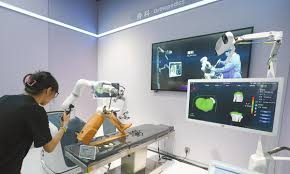
Introduction: AI Reshaping Global Healthcare
Artificial intelligence is transforming China’s hospitals at a rapid pace. As a result, a critical global conversation has emerged — one that mirrors older debates in international health. How do we balance innovation with safety? How do we align national ambition with global responsibility? And how do we match technological speed with public trust?
Christoph Benn knows these questions well. A veteran of international health cooperation and one of the founders of the Global Fund, Benn has spent decades working with governments, United Nations agencies, and healthcare systems across Asia, Africa, and Europe. He sees China’s medical AI push not as a departure from global norms, but as part of a longer worldwide trajectory.
Balancing Innovation with Safety
AI Must Earn Public Trust
“Artificial intelligence can make healthcare more effective and more efficient,” said Benn, director of the JLI Center for Global Health Diplomacy in Geneva. “But those benefits are not automatic. AI must be used responsibly, according to clear guidelines and standards, so that people can trust it.”
Benn also chairs the board of Health AI — the global agency for responsible AI in health. He points out that global health has long confronted cross-border challenges: pandemics, drug resistance, and unequal access to care. Consequently, the governance tools built during those battles are directly relevant to medical AI today.
Transparency and Accountability Are Non-Negotiable
In China, AI systems increasingly influence medical diagnoses, surgical planning, and hospital management. Questions of liability, transparency, and oversight — once debated in the context of pharmaceuticals and vaccines — are now resurfacing in digital form. Therefore, the lessons from earlier healthcare governance frameworks carry enormous weight.
Why Regulation Enables Progress
Rules Protect Patients, Not Just Systems
“Regulation is not about slowing innovation,” Benn emphasizes. “It’s about making sure systems are safe, validated, and accountable — especially when decisions affect human lives.”
This perspective challenges the assumption that oversight stifles technological growth. Instead, effective regulation builds the trust that allows adoption to accelerate. Moreover, without clear standards, AI tools risk causing harm at scale before problems are even detected.
Nations Need Independent Evaluation Capacity
What international experience offers China, according to Benn, is not a ready-made regulatory model. Rather, it is a mindset: technology must be embedded within institutions capable of evaluation and correction, not simply deployed at scale.
“Every country needs the ability to assess, certify, and validate the AI tools they want to use,” he said. “That capacity must not be limited to wealthy nations.”
China’s AI Health System at Scale
From Pilot Programs to National Rollout
China’s recent policy moves — from national AI action plans to local pilot programs and training centers — reflect a growing awareness that technology alone cannot transform healthcare. Governance, Benn argues, is an essential part of the infrastructure. It must develop at the same pace as hardware and software.
A Real-World Laboratory for Medical AI
Unlike many countries where AI adoption remains fragmented and market-driven, China’s public insurance system and centralized planning allow new technologies to be tested, adjusted, and rolled out rapidly. From AI-assisted diagnostics and remote surgery to the newly developed Agent Hospitals, China has become a global laboratory for medical AI implementation.
“These are not theoretical discussions,” Benn noted. “They are happening in clinical settings, with real patients.”
Furthermore, China’s ability to deploy solutions across an entire health system — not just in individual hospitals — sets it apart from most other nations.
Bridging the Global Health Divide
AI Can Reach Underserved Communities
For countries in the Global South, China’s experience holds particular relevance. Benn recalled his time as a medical doctor in rural Africa, where hospitals lacked even basic computers. Today, mobile connectivity and AI-supported diagnostics are changing that reality.
“Things that were impossible before are becoming realistic,” he said. “That is a profound change.”
Inequality Is a Design Problem, Not an Inevitability
Critics often worry that AI will widen existing health inequalities. Benn does not dismiss that concern. However, he firmly rejects the idea that inequality is inevitable.
“Some people worry that AI will increase inequality. But inequality already exists,” he said. “The real question is whether we design systems so that low-income and resource-limited settings can benefit.”
Shared standards, open evaluation frameworks, and technology transfer can prevent a future where advanced medical AI remains confined to elite hospitals in wealthy cities.
The Role of International Cooperation
Regulators Must Talk to Each Other
Benn is currently involved in efforts to build international networks that bring regulators, researchers, and health authorities together. The goal is not to impose uniform rules. Instead, it is to enable mutual recognition and shared learning across borders.
“Hospitals cannot regulate themselves in isolation,” he said. “Governments need regulatory authorities, and those authorities need to talk to each other.”
China Has Much to Offer the World
If China has much to learn from international cooperation, Benn believes it also has much to contribute.
“China’s experience matters because it shows how innovation works at scale,” he said. “Not in one hospital, but across an entire health system.”
Ultimately, this global exchange of knowledge — across regulatory bodies, health ministries, and research institutions — is the foundation for equitable and responsible medical AI worldwide.
Key Takeaways
- Medical AI in China is advancing rapidly and raising global governance questions.
- Responsible AI use requires clear standards, transparency, and institutional oversight.
- China’s centralized health system enables faster AI testing and national deployment.
- International cooperation is essential to prevent AI from deepening health inequalities.
- Nations at all income levels must build capacity to evaluate and validate AI tools